Library of Antique English Bibles 1390 to 1846




History"..hard to kick against the pricks" - Acts 9:5
 ohn Wycliffe was born in Ipreswell, Yorkshire, England in the 14th century. It was a time of political instability, natural disasters and famine. Roman Catholic Church power was declining and tensions sparked between England and France. This then ignited the Hundred Years' War between the two kingdoms.
In 1348 the bubonic plague -The Black Death- began to ravage Europe and Britain. It claimed 30-60% of Europe's total population. By 1353 an estimated 75 to 200 million people lost their lives to the plague claiming it to be one of the most devastating pandemics in human history. Some, blaming the Jews, the rich and the Catholic Church for the plague; people lost faith and witchcraft was revitalized. Some also believed that the end of the world was at hand and the plague was the judgement of God on sinful mankind.
 This started movements such as Flagellantism; which has its roots from occultic practices i.e cult of Isis, Donysian's and ancient Rome. Consisting of radicals in the Roman Catholic Church this militant pilgrimage rituals consisted of self-mortification whereby radicals would whip themselves until they bleed in the cities and other public spaces. It served as a demonstration of piety and forms of repentance. These movements were later condemned by the Catholic Church as heretical and were on guard against heretical and creative theology.
While the The Black Death subsided in Europe, it never really came to an end in England throughout Wycliffe's lifetime. Being a scholastic philosopher, theologian, lay preacher, translator, reformer and university teacher Wycliffe was considered as one of the most influential Roman Catholic Church opposers of the 14th century. His views was greatly shaped early in his life by archbishop Thomas Bradwardine’s book - On the Cause of God against Pelagians.
 Also being moved by the impact of The Black Death, Wycliffe saw the plague as an indictment of an unworthy clergy. Wycliffe considered those that replaced the unworthy clergy as uneducated and disreputable. Wycliffe then soon produced a small treatise called The Last Age of the Church after completing his arts degree.
He then being compelled with the need for an English translation of the Bible, Wycliffe set about to produce a world first translation. He translated it in Middle English using the Latin Vulgate as the primary source. Though relatively few people could read at that time, the idea was to translate the Bible into the vernacular. Wycliffe stated saying "it helpeth Christian men to study the Gospel in that tongue in which they know best Christ's sentence".
His work soon became popular and he gained followers. His followers were considered rebellious being anticlerical, preaching biblically centred reforms and was known as the Lollards; which is also later known as Wycliffites. The Lollard movement was a predecessor to the Protestant Reformation with Wycliffe known as the Morning Star of the Reformation.
With his work being unauthorized by the Roman Catholic Church, the kingdom of England and England’s established Catholic Church began to undertake a drastic campaign to suppress the translation. Lollardy was later denounced as heresy punishable by severe torture or death. Under the protection of the University of Oxford on the grounds of academic freedom Wycliffe spent his last days fighting the good fight for Scripture. His drive towards the end portrayed that Scripture was the authoritative centre of Christianity, deeming the papacy unhistorical and that monasticism was irredeemably corrupt. He also expressed that the moral unworthiness of priests invalidated their office and sacraments.
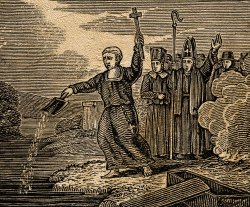 On the 28th of December, Wycliffe suffered a stroke and died as the year ended in 1384. An Anti-Wycliffe Statute of 1401 extended further persecution to Wycliffe's followers and in 1415 his writings were banned as it was declared heretical by the Council of Constance. To further express hatred towards Wycliffe, an order was carried out in 1428 by Pope Martin V whereby Wycliffe's bones were dug up, burned and his ash was cast into River Swift.
Today more than 250 manuscripts of the Wycliffite Bible survive. The above Wycliffe pocket new testament translation used by a roving Lollard preacher is one these. Please join thewordofgod.co.za in appreciating a page by page passion extended towards the fight for the Gospel of Christ against those who deemed it "hard to kick against the pricks" (Acts 9:5).